SECURITY MONITORING
OTTAWA
Security monitoring Ottawa businesses and institutions rely on for 24/7 alarm response, video verification, and professional dispatch. Family Security connects commercial clients to ULC-listed monitoring stations with response protocols built for Ottawa offices, retail, warehouses, multi-site operations, and institutional facilities across the National Capital Region.
Get a Monitoring Quote →
SECURITY MONITORING SERVICES
FOR 6 COMMERCIAL NEEDS
Our security monitoring Ottawa configurations are built around your facility’s alarm infrastructure, camera system, response requirements, and operating hours — not generic monitoring packages that apply the same protocol to every client.
Professional security monitoring Ottawa is most effective when integrated with a properly designed alarm system and security camera systems. Video verification adds a critical layer — operators confirm events before dispatching — reducing false alarm fees and ensuring every police or fire dispatch is for a verified incident.
For ULC standards and monitoring certification information, the Government of Canada provides guidance on insurance and security certification requirements. Most commercial insurance policies and property leases in Ottawa specify ULC-listed monitoring as a condition of coverage — our monitoring partners meet this standard.
24/7 Alarm Monitoring
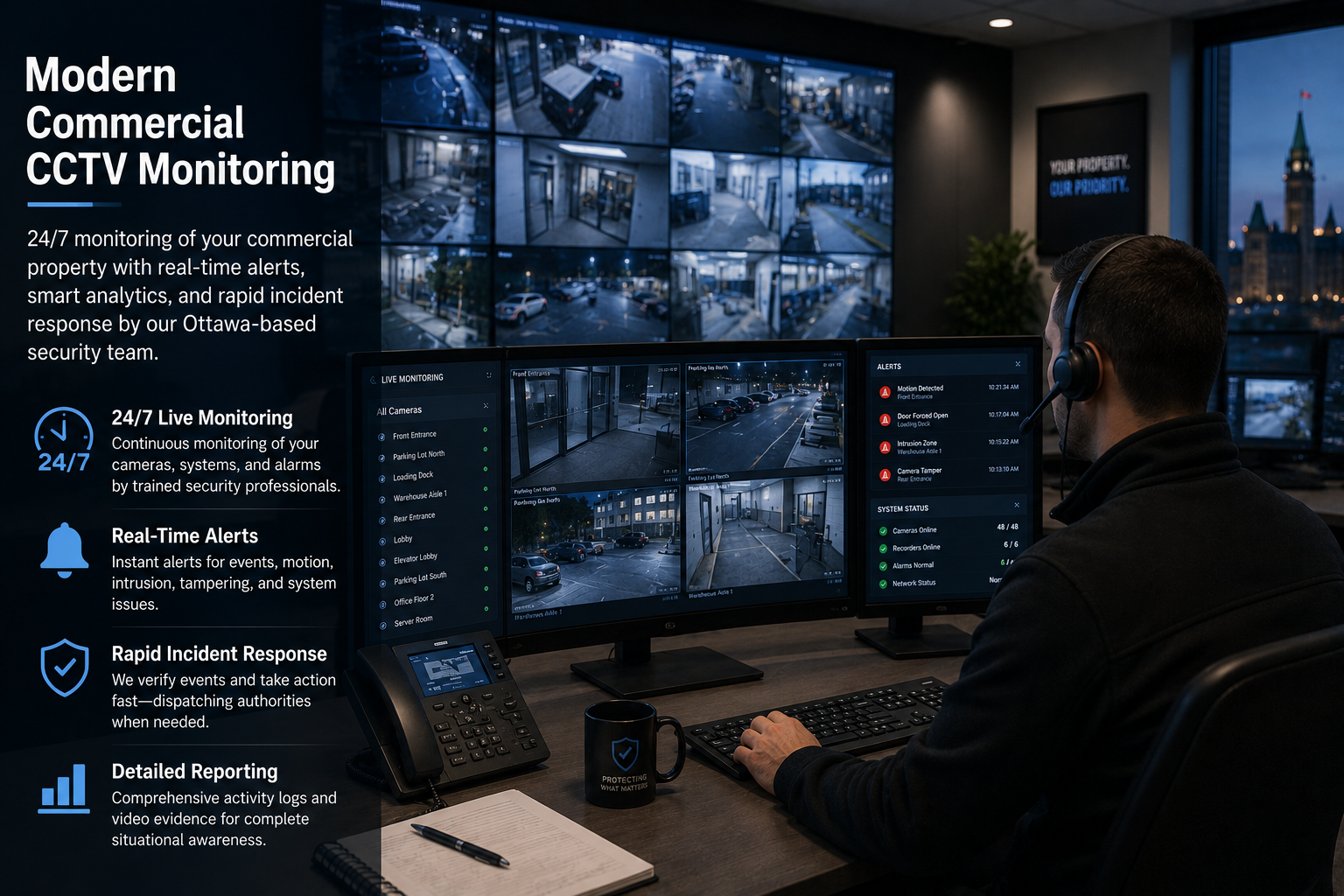
Round-the-clock security monitoring Ottawa for intrusion alarms, door contacts, motion sensors, and duress signals — with ULC-listed central station response every hour of every day, including holidays.
Video Verification
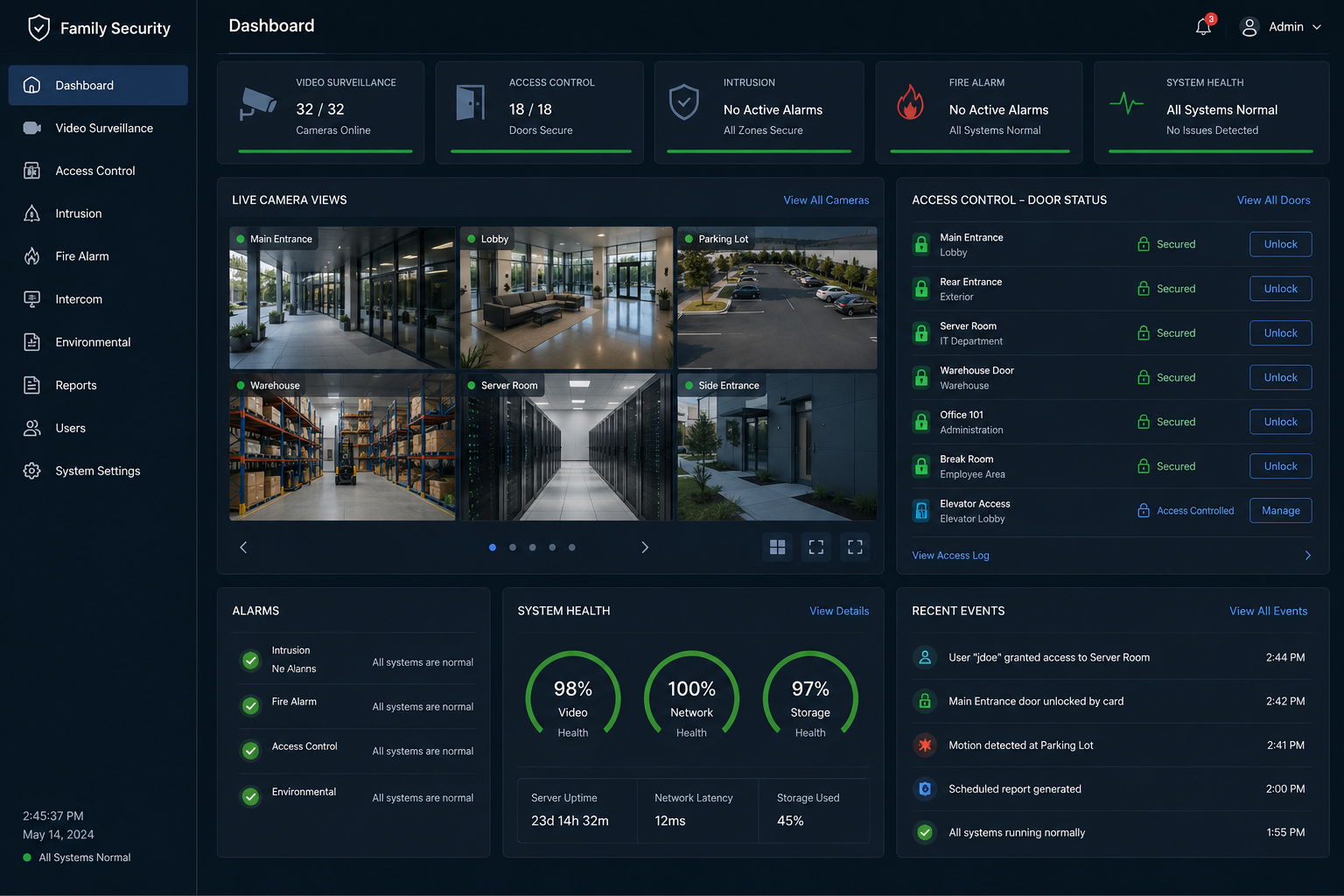
Monitoring operators access live camera feeds to confirm alarm events before dispatching police or fire services — reducing false alarms, lowering dispatch fees, and ensuring security monitoring Ottawa responses are for confirmed incidents.
Police & Fire Dispatch
Verified alarm events trigger immediate police or fire dispatch from the monitoring station, with documented response protocols that meet Ottawa bylaw requirements and commercial insurance standards for security monitoring Ottawa accounts.
After-Hours Response Coordination
Customized response protocols for each account — call-down lists, keyholder contacts, and escalation procedures that define exactly who is contacted, in what order, for each alarm type in your security monitoring Ottawa configuration.
Multi-Site Monitoring
Centralized security monitoring Ottawa across multiple business locations — all sites under one account, one service agreement, and consistent response protocols managed from a single monitoring relationship.
ULC-Listed Central Station
All security monitoring Ottawa accounts are connected to ULC-listed monitoring stations — the certification standard required by most Ottawa commercial insurance policies and institutional security specifications.
OTTAWA’S COMMERCIAL
MONITORING SPECIALISTS
Effective security monitoring Ottawa requires more than a monitoring subscription. It requires a properly designed alarm system, integrated camera verification, and response protocols configured for your specific facility and risk profile.
System + Monitoring, One Partner
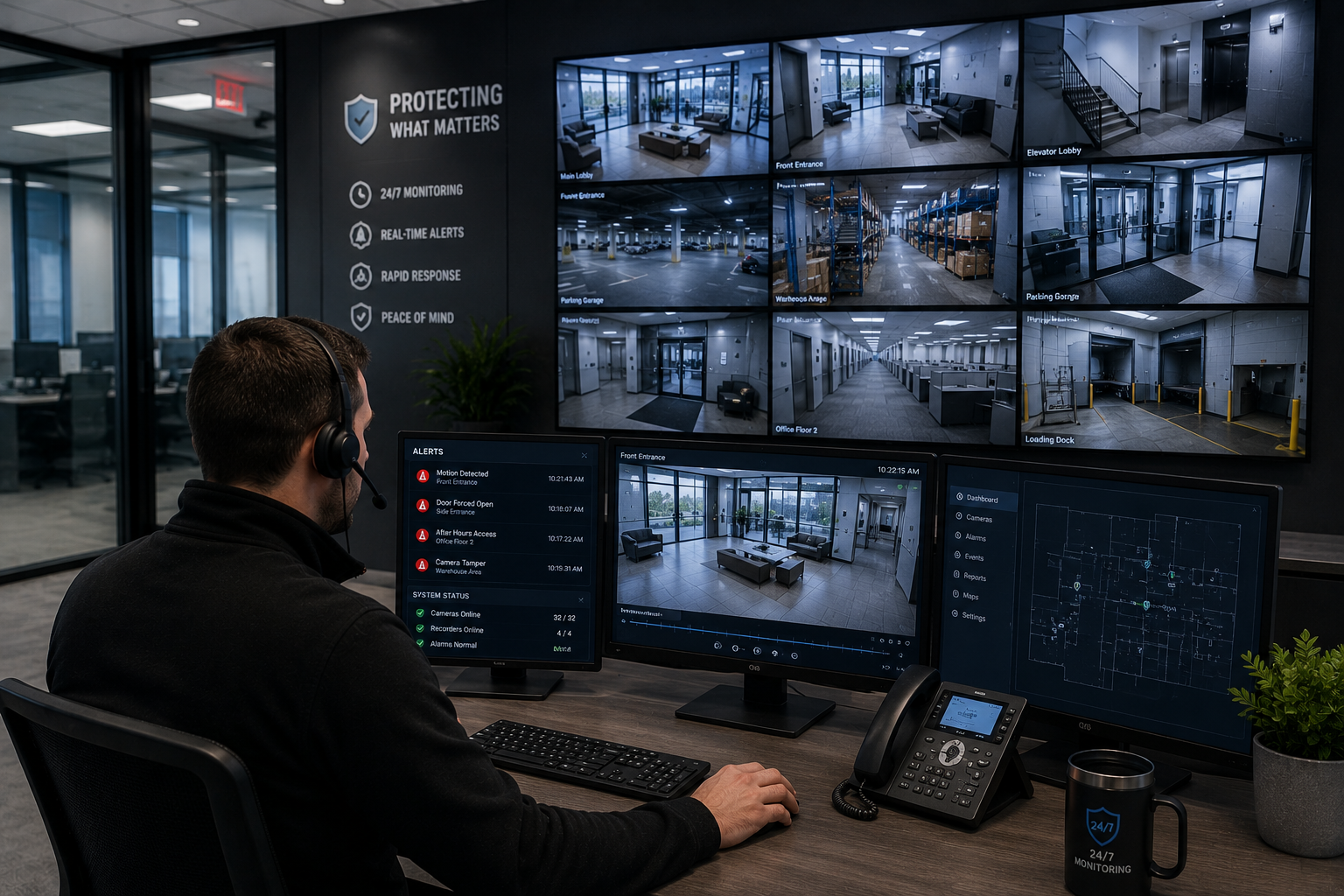
We design the alarm system, install the infrastructure, connect the monitoring account, and configure your response protocols — so your security monitoring Ottawa setup works as a complete system, not a collection of disconnected products from separate vendors.
ULC-Listed Monitoring Partners
Every security monitoring Ottawa account we connect meets ULC standards — the certification required by commercial insurance policies, institutional procurement, and property management agreements across Ottawa and Eastern Ontario. Multi-tenant building operators can scope monitoring and access needs with our multi-tenant building security checklist.
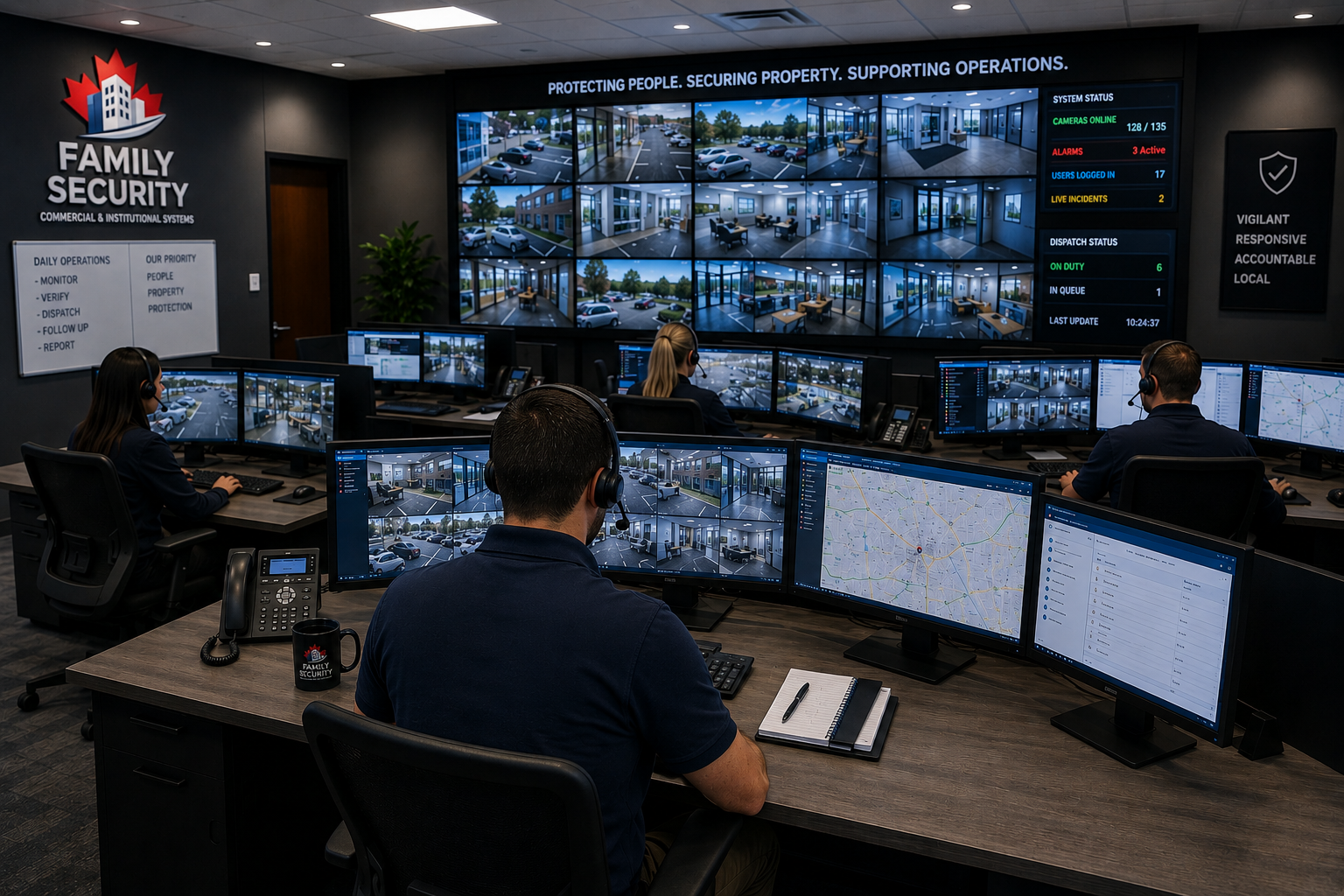
Video Verification Capability
For clients with camera systems, we configure video verification so monitoring operators can confirm events before dispatching — reducing false alarm costs and improving response precision for security monitoring Ottawa commercial and multi-site accounts.
Local Team, Long-Term Support
Our Ottawa-based team handles service calls, system changes, and monitoring account updates. Security monitoring Ottawa clients don’t reach a national queue — they reach the same local team that installed their system.
How Security Monitoring Ottawa Commercial Clients Receive Actually Works
Professional security monitoring Ottawa starts with the alarm system infrastructure at your facility — door contacts, motion detectors, glass break sensors, duress buttons, and in many cases camera feeds. When an alarm signal is generated, it is transmitted to a ULC-listed central monitoring station, where a trained operator receives the signal and initiates a response protocol specific to your account. That protocol defines what the operator does next: attempt to reach a keyholder, dispatch police or fire services, or access camera feeds for video verification before taking action.
Response protocols are the most important configuration element of any security monitoring Ottawa account — and the element most often left at a generic default. A well-configured protocol specifies the exact sequence of actions for each alarm type. An after-hours motion trigger in a server room might require calling the IT manager before dispatching police. A duress alarm at a reception desk might require immediate police dispatch with no keyholder call first. A door-held-open alert at a loading dock might require only a keyholder notification, not a police response. These distinctions prevent unnecessary dispatches and ensure that genuine emergencies receive the fastest possible response.
False alarm management is a practical operational issue for every security monitoring Ottawa commercial client. Ottawa and the surrounding municipalities charge fees for police responses to false alarms — fees that accumulate quickly in businesses with poorly configured alarm zones, equipment that triggers on environmental conditions, or staff who are not trained on the arming and disarming procedure. Professional monitoring with a properly configured protocol and video verification reduces false alarm dispatches to a minimum. When a false alarm does occur, our team reviews the cause and recommends a configuration adjustment to prevent recurrence.
Keyholder management is the administrative layer of security monitoring Ottawa that businesses frequently underestimate until an incident occurs after hours. The monitoring station needs an accurate, current list of keyholders — individuals who can be reached, who have physical access to the facility, and who have the authority to authorize a police stand-down or confirm that an alarm was user-generated. Outdated keyholder lists mean an after-hours alarm results in police arrival at a facility where no one can be reached to confirm the situation — which has liability and operational implications. We help clients structure and maintain keyholder lists as part of the monitoring account setup.
BUILDING THE ALARM SYSTEM THAT FEEDS YOUR SECURITY MONITORING OTTAWA ACCOUNT
The quality of security monitoring Ottawa commercial clients receive is directly tied to the quality of the alarm infrastructure generating the signals. A poorly zoned alarm system with sensors positioned for convenience rather than threat detection, programmed with generic factory defaults, and connected to a monitoring station through a basic communicator will generate unreliable signals, frequent false alarms, and limited useful information for the monitoring operator. A professionally designed system generates clean, specific signals that give the monitoring station what it needs to respond correctly.
Zone design is the foundation. Each alarm zone in a well-configured security monitoring Ottawa system represents a specific, logical area — the server room is one zone, the loading dock is another, the executive floor is a third. When an alarm is triggered, the monitoring operator immediately knows the location, which informs the response. A single-zone “entire building” alarm produces one data point: something happened somewhere. A multi-zone design produces specific, actionable information that makes both the monitoring response and the post-incident investigation significantly more effective.
Communicator technology affects the reliability of the connection between your alarm panel and the monitoring station. Older systems use POTS (plain old telephone service) communicators that are increasingly unreliable as telephone infrastructure changes. Modern security monitoring Ottawa deployments use cellular or IP communicators with supervision signals — the monitoring station receives a periodic heartbeat from the panel, and an alert is generated if the signal is lost. This means a communication failure is detected proactively, not only after an alarm fails to transmit.
Camera integration with alarm monitoring creates the video verification layer. When a camera is associated with a specific alarm zone in a security monitoring Ottawa account, the monitoring operator can access that camera’s feed when an alarm from that zone is received — confirming whether the event is an intrusion, an environmental trigger, or a user error before deciding whether to dispatch. This confirmation step is the most effective single intervention for reducing false alarm dispatches and their associated costs.
Access control integration adds a third data layer. When access control events — a door forced open, a credential used outside its authorized time window, an after-hours access attempt — are routed to the monitoring platform, the monitoring operator receives context that an alarm signal alone cannot provide. For security monitoring Ottawa clients managing high-security zones or after-hours access protocols, this integration makes the monitoring service significantly more responsive to the actual events occurring at the facility.
Documentation and reporting are part of what a professional security monitoring Ottawa relationship provides. Monitoring stations maintain records of every alarm signal, operator action, and dispatch event — records that are available to the client on request and that serve as evidence for insurance claims, incident investigations, and compliance reporting. For regulated industries and institutional clients in Ottawa, this documentation trail is not optional — it is a requirement of their security policy and insurance coverage. We ensure our clients’ monitoring accounts are configured to generate the documentation their specific environment requires.
What Ottawa Businesses Should Understand Before Signing a Security Monitoring Ottawa Agreement
The security monitoring Ottawa market includes a wide range of providers — national monitoring companies, local alarm dealers, bundled telecom offerings, and DIY app-based services. These options vary significantly in their certification standards, response protocols, contract terms, and actual performance during a real alarm event. Understanding the differences helps Ottawa business owners select a monitoring arrangement that meets their insurance requirements, delivers reliable response, and does not create contractual problems down the road.
ULC listing is the starting point for evaluating any security monitoring Ottawa provider for commercial use. ULC (Underwriters Laboratories of Canada) certifies central monitoring stations against a defined set of operational standards — physical security of the facility, redundant communication infrastructure, operator training requirements, and documented response procedures. A ULC-listed station has undergone third-party verification that it meets these standards.
Most commercial insurance policies in Ottawa require ULC-listed monitoring as a condition of coverage for burglary, theft, and certain property damage claims. A business that discovers its monitoring provider is not ULC-listed after a claim is denied faces both an uninsured loss and the cost of upgrading its monitoring arrangement — a situation that is entirely avoidable at the point of selection.
Contract terms for security monitoring Ottawa services vary widely and are a frequent source of disputes between businesses and monitoring providers. Standard monitoring agreements range from month-to-month arrangements to three or five-year contracts with automatic renewal clauses. The automatic renewal clause is particularly important to understand: many monitoring contracts require written notice of cancellation 30, 60, or even 90 days before the renewal date, or the contract automatically renews for another full term.
Missing this window locks the client into another multi-year agreement regardless of their satisfaction with the service. Before signing any monitoring contract, confirm the initial term, the renewal structure, the cancellation notice period and procedure, and whether the monitoring account is portable — meaning you can transfer it to a new provider without losing your alarm system configuration.
Response time standards vary between security monitoring Ottawa providers and are rarely disclosed proactively. The critical metric is the time between signal receipt and operator action — specifically, how quickly an operator acknowledges an alarm signal, initiates the response protocol, and makes the first outbound contact (keyholder call or dispatch). Industry standard for ULC-listed stations is under 60 seconds for an alarm signal to receive operator attention.
Providers that route signals through offshore or remote processing centres — common in lower-cost monitoring offerings — may have significantly longer response times that are not disclosed in marketing materials. For Ottawa businesses in sectors where fast response matters, asking specifically about signal-to-action time is a reasonable and important question.
Testing your security monitoring Ottawa account regularly is a practice most businesses establish at installation and then never repeat. A monitoring account that has not been tested in two years may have accumulated keyholder list changes, phone number updates, and system modifications that have not been communicated to the monitoring station.
The practical consequence is that when an actual alarm occurs, the operator reaches disconnected phone numbers, calls keyholders who no longer work at the organization, or dispatches to an old address. Testing should occur at least annually — and every time a keyholder list changes or a significant system modification is made. We schedule test calls as part of our maintenance service so clients don’t need to remember to initiate them.
False alarm management is an operational and financial issue for most security monitoring Ottawa commercial accounts. Ottawa’s false alarm bylaw imposes fees on properties that generate repeated police dispatches to false alarms — fees that are assessed to the property address and can accumulate to hundreds or thousands of dollars annually in businesses with poorly configured systems or undertrained staff. The most common causes of false alarms are user error (incorrect disarming after entering), environmental triggers (HVAC-induced motion sensor activations, insects in passive infrared sensors), and equipment malfunction.
A professionally configured alarm system with appropriate entry and exit delays, zone exclusions for known environmental trigger areas, and staff training on the arming and disarming procedure addresses most false alarm causes before they generate a dispatch. Video verification adds a final layer — confirming whether a triggered alarm represents an actual event before dispatch is made.
Redundant communication paths are a technical requirement for any security monitoring Ottawa account that cannot afford a communication failure during an active alarm event. Standard monitoring connections use a primary and a backup communicator — typically a primary IP path over the facility’s internet connection and a secondary cellular communicator that transmits independently if the primary path fails.
This redundancy matters because cutting the internet connection at a commercial property is a straightforward act for a knowledgeable intruder. A cellular backup communicator transmits over the mobile network regardless of what happens to the facility’s wired infrastructure — ensuring the monitoring station receives the alarm signal even if the intruder has disabled the primary communication path.
Monitoring documentation and reporting support insurance compliance and incident investigation for security monitoring Ottawa commercial accounts. ULC-listed monitoring stations maintain records of every alarm signal received, operator action taken, dispatch made, and keyholder contacted — with timestamps accurate to the second. These records are available to the account holder on request and serve as contemporaneous evidence for insurance claims and legal proceedings.
For Ottawa businesses in regulated industries, healthcare, or government-adjacent environments, monitoring documentation is frequently required as part of their security policy compliance. We ensure every monitoring account we establish is configured to generate the records our clients need and that clients understand how to request those records when they are needed.
SECURITY MONITORING OTTAWA — FAQ
Common questions about security monitoring Ottawa businesses and facility managers ask when setting up or upgrading their alarm monitoring service.
What security monitoring services does Family Security offer in Ottawa?
Family Security connects Ottawa commercial clients to professional 24/7 security monitoring Ottawa — including alarm signal monitoring, video verification, police and fire dispatch, and after-hours response coordination. All monitoring accounts are connected to ULC-listed central monitoring stations that meet Canadian insurance and commercial property requirements.
What is video verification in security monitoring?
Video verification is the process where a monitoring operator views live or recorded camera footage before dispatching a response to an alarm signal. For security monitoring Ottawa commercial clients, video verification significantly reduces false alarm dispatches — which reduces police false alarm fees and ensures that when a dispatch call is made, it is for a confirmed event rather than an environmental trigger.
Does security monitoring reduce false alarms for Ottawa businesses?
Yes. Professional security monitoring Ottawa businesses receive through a properly configured alarm system with video verification significantly reduces false alarm dispatches. False alarm fees from Ottawa bylaw and police services can be substantial — professional monitoring with a response protocol and video verification layer reduces those costs while maintaining genuine emergency response capability.
Can security monitoring cover multiple Ottawa locations?
Yes. Security monitoring Ottawa multi-site businesses need is configured as a centralized account — all locations report to the same monitoring station, under one service agreement, with standardized response protocols across every site. This simplifies management, ensures consistent response procedures, and provides a single point of contact for alarm events across your Ottawa portfolio.
What is a ULC-listed monitoring station and why does it matter in Ottawa?
ULC (Underwriters Laboratories of Canada) listing is the certification standard for central station alarm monitoring in Canada. Security monitoring Ottawa commercial and institutional clients receive through a ULC-listed station meets the requirements of most commercial insurance policies, property leases, and institutional security standards. Non-listed monitoring may not satisfy insurance documentation requirements — a detail that can affect coverage after an incident.
EXPLORE RELATED SECURITY PAGES
Monitoring is most effective as part of a complete system — combined with alarm infrastructure, camera verification, and access control. Explore related pages below.
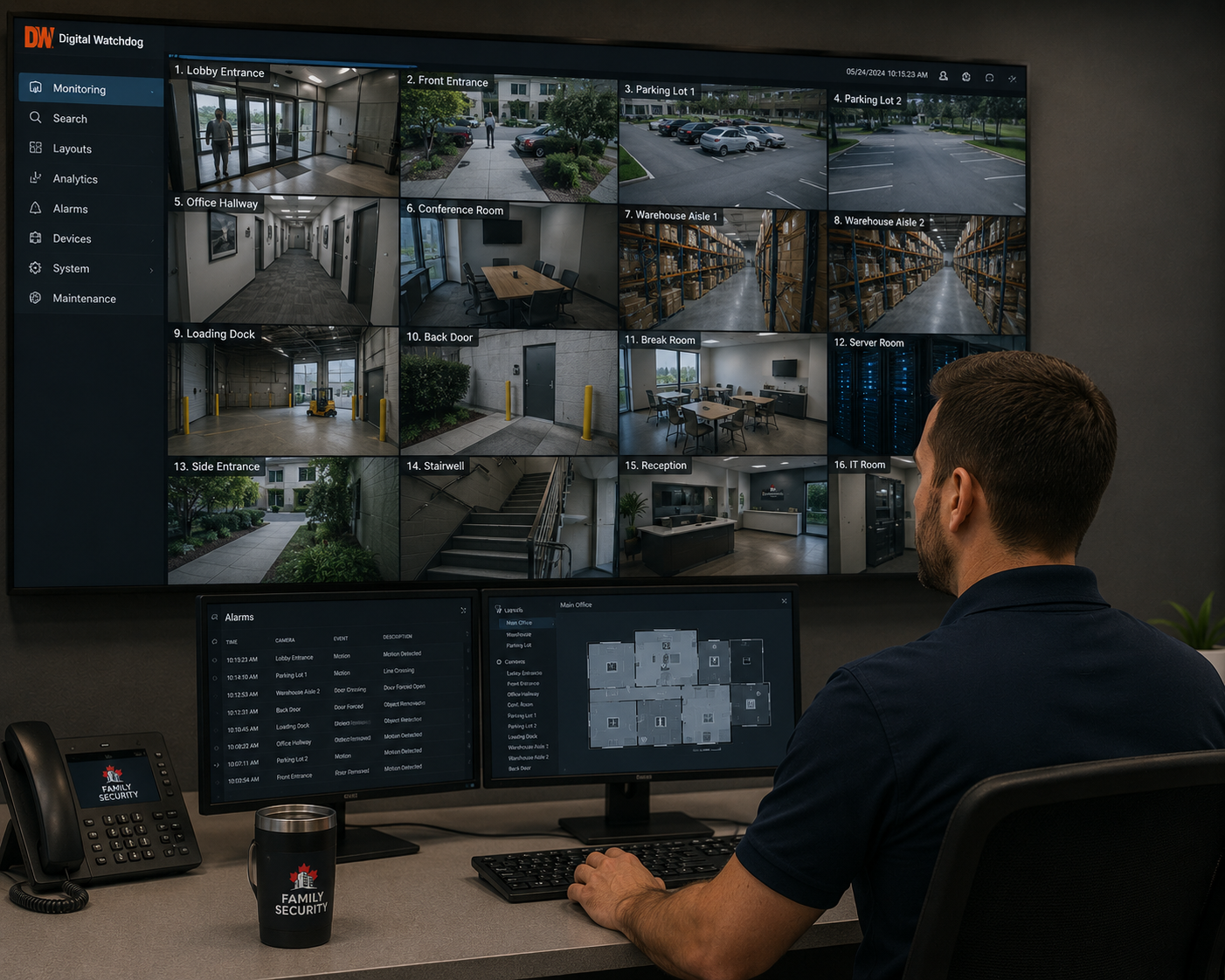
Security Camera Systems Ottawa
NDAA-compliant commercial CCTV with video verification capability — integrated with your monitoring account for confirmed event dispatch.
Access Control Ottawa
Enterprise access control systems that integrate with alarm monitoring — door events, after-hours alerts, and forced-door signals routed to your monitoring account.
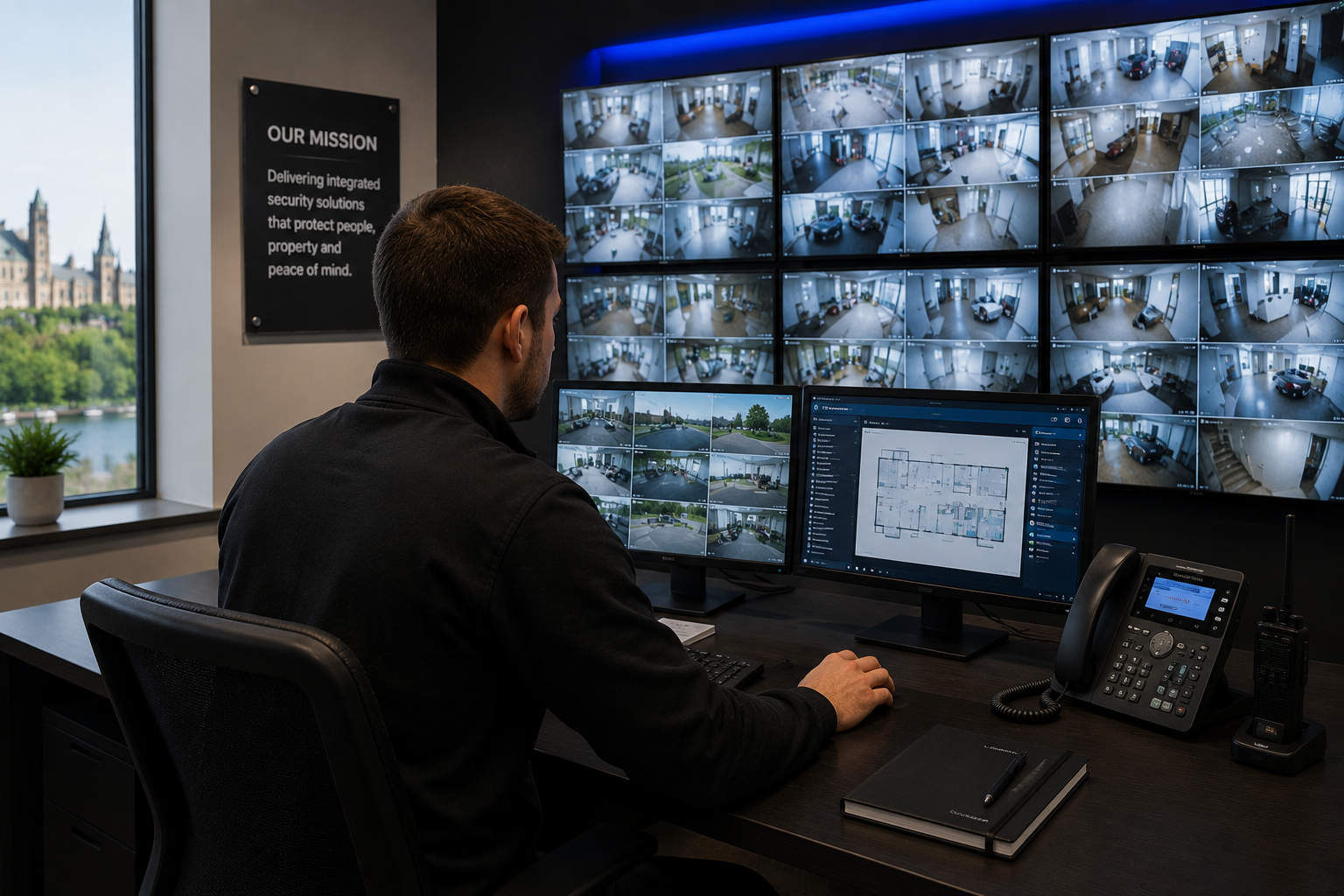
Commercial Security Systems Ottawa
Full commercial security packages combining access control, CCTV, alarm systems, and professional monitoring for Ottawa offices, retail, and multi-site businesses.
SECURITY MONITORING ACROSS OTTAWA & EASTERN ONTARIO
We connect commercial clients to professional security monitoring Ottawa businesses across the full National Capital Region rely on — from one Ottawa-based certified team.
As Ottawa’s trusted Ottawa security company, we also deliver alarm systems Ottawa businesses rely on, commercial security systems, and ongoing maintenance. See our security systems FAQ or request a monitoring quote.